
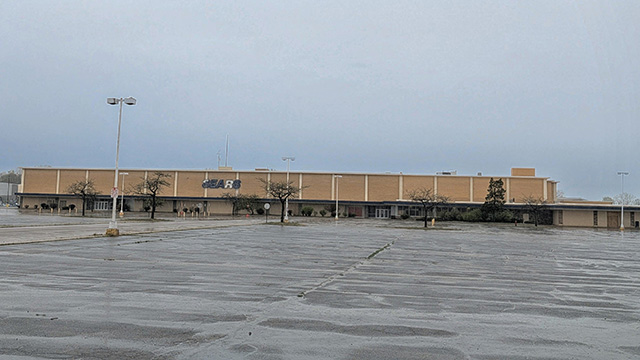
Photo by author
In 1984, the New York Times profiled Sears, Roebuck and Company as a financial empire.¹ Its mail-order catalog was widely referred to as the “Consumer’s Bible.” Roughly fifty percent of American households held a Sears credit card. At its peak, Sears employed approximately 350,000 people and operated thousands of stores across the country. It was not just a retailer. It was a cultural force woven into American life.
By October 2018, Sears filed for Chapter 11 bankruptcy. 700 stores remained. 68,000 people still worked there.² As of this writing, fewer than a handful are still open—if any. A 130-year-old American institution, effectively gone.³
The conventional explanation is disruption. Amazon ate retail. Walmart undercut on price. Sears failed to adapt. This explanation is tidy, intuitive, and wrong.
Sears was not disrupted. It was optimized for extraction.
The Operator
Eddie Lampert was not a retail executive. He was a hedge fund manager, Goldman Sachs trained and Yale educated, managing $15 billion through his fund ESL Investments by age 41.⁴ In 2004, BusinessWeek put him on its cover with the headline “The Next Warren Buffett.”⁵
In 2005, Lampert merged the bankrupt Kmart (which ESL had acquired) with Sears, creating Sears Holdings Corporation. He became chairman of the board. By 2013, he was CEO.⁶ He had no retail experience. He did not believe he needed any.
What Lampert brought was a framework. And it worked exactly as designed.
The Framework
Shareholder primacy is a corporate governance theory that managers’ primary duty is to maximize shareholder wealth. Milton Friedman was a Nobel Prize winner, advisor to a US President and UK Prime Minister, and the leading economist responsible for the free-market capitalism movement of the late 20th century. Friedman argued that when managers spend company resources on things that do not directly benefit shareholders—reducing pollution beyond legal requirements, employee benefits beyond the need to remain competitive, enhancements that go beyond customer needs—they are effectively spending shareholders’ money without their consent. Shareholders are the owners of the corporation, and therefore corporate executives have a direct responsibility to serve their interests, which is generally to make them as much money as possible. In order for shareholders to make a profit, a company does not need to be profitable.
Therefore, decisions are made to maximize payouts to shareholders by ruthless elimination of waste. Waste is defined as anything that a customer is unwilling to pay for. The “customer” in shareholder primacy is the shareholder. Everything else—employees, buyers, communities, brand equity—is instrumental. Useful when it serves the goal. Excess when it doesn’t.
As the largest shareholder, Lampert took this duty to heart.
The Playbook
Step 1: Load the debt. In 2005, Lampert used Kmart to acquire Sears in an $11 billion merger, creating Sears Holdings Corporation.⁷ A move made possible by the cash and real estate he’d already extracted from Kmart’s 2003 bankruptcy. Over the years that followed, ESL and its affiliates lent Sears billions of dollars, accumulating $2.6 billion in debt and earning hundreds of millions in interest and fees.⁸ The company didn’t inherit its debt problem. It was given one.
Step 2: Internal competition. In 2008, Lampert restructured Sears into more than 30 competing business units (later growing to roughly 40), each with its own president, board, chief marketing officer, and profit-and-loss statement.⁴ Units competed for resources, and only the strongest performers won them. The structure promoted the elimination of inefficiencies through competition. Units optimized for their own scorecards, undermining cost centers and running conflicting marketing campaigns.
Step 3: Slash investment. Capital expenditure on stores was cut to near zero. No renovations. No upgrades. No maintenance. Cash that should have gone into the business was redirected to paying off Sears’ debt and stock buybacks that enriched shareholders. Lampert, through ESL, was both the holder of most of the debt and the largest shareholder.⁹
Step 4: Brand Spin-off. In 2014, Lampert spun off Lands’ End to shareholders. This transferred a premier brand—and its cash flow—away from the retail entity, ensuring that if Sears failed, the profitable business was already safely in the hands of the investors.¹⁰
Step 5: Sale-leaseback. In 2015, Lampert spun off 235 of Sears’ most valuable store locations (and 31 additional properties) into a publicly traded real estate investment trust called Seritage Growth Properties for $2.7 billion.⁹ Under the sale-leaseback arrangement, Sears transferred property ownership to Seritage, freed up cash without taking on new debt, and entered long-term rental agreements to continue occupying the stores it used to own. By 2018, Sears had paid Seritage $349 million in rent, plus $45 million in termination payments from shuttered locations.⁹ Lampert was chairman of Seritage. His hedge fund held a significant ownership stake.⁹
Step 6: Liquidation. In 2017, Sears sold its iconic tool brand, Craftsman, to Stanley Black & Decker for approximately $900 million.¹¹ DieHard batteries were sold off. Kenmore appliances were offered to Amazon. Each sale generated cash. That cash serviced debt. Much of that debt was owed to Lampert’s own hedge fund.⁹
Step 7: The exit strategy. Stripped of its assets and any means for profitability, Sears declared bankruptcy in 2018. The company went down with the debt, while Lampert and his affiliates walked away with the cash. Lampert then bid to buy what was left of Sears out of bankruptcy through ESL, the same hedge fund that held its debt. He used a credit bid, applying the $2.6 billion in debt ESL held as currency for the purchase.¹² This prevented him from having to pay actual cash, and prevented rival bids from anyone who would. This also bypassed straight liquidation, where remaining assets are sold off at a fraction of face value. Instead, he received all remaining real assets under a new entity that could be loaded with debt and extracted from again. The man who drove the company into the ground offered to buy the remains. Through the entity that profited from its decline.
The courts fought over it for years. The original bankruptcy court decision in 2019 was upheld by the Southern District of New York, then by the Second Circuit Court of Appeals. On March 20, 2023, the Supreme Court declined to hear the case. Certiorari denied. The original ruling stood.¹³
By the end, Lampert had been simultaneously the CEO running the company, the chairman of the board overseeing it, the landlord collecting rent from it, and the largest creditor it owed money to. ESL had finished harvesting Sears. The extraction was complete.
The Math
Creditors estimated that between debt service, rent payments, and asset spinoffs, somewhere between $900 million and $1.5 billion was extracted before bankruptcy. After bankruptcy, another $1.5 to $2 billion was potentially in play.⁹
Every transaction was disclosed. Every deal was approved by the board. The structure was legal. And the money, at every stage, moved from entities where Lampert had fiduciary obligations to entities where Lampert had ownership stakes.
The billions in losses Sears generated were not failures; they were “deferred tax assets.” The structure allowed Lampert to use Sears’ “failures” to shield profits in other ventures from the IRS. At the time of bankruptcy, Sears had accumulated roughly $5.7 billion in Net Operating Losses (NOLs). Under Section 382 of the Internal Revenue Code, these losses can be “carried forward” to offset future taxable income. In the bankruptcy proceedings, Lampert’s team fought to preserve these NOLs so they could be used by his new entity, Transformco, to shield future profits from taxes.¹⁴
The conventional narrative assumes the goal was for Sears to remain profitable. But by the logic of shareholder primacy, this was a success. Capital was allocated to its highest-returning use. Underperforming assets were liquidated. Value was extracted and redirected to shareholders. The business model worked precisely as advertised.
What the Dashboards Showed
In my book I Think, Therefore I Know, I describe what happened inside Sears at the operational level: a metrics-driven management approach that pitted business units against each other, rewarded aggressive cost-cutting, and produced scorecards that all showed green while the company disintegrated underneath.
Every unit hit its targets. Costs decreased. Efficiency metrics improved. The dashboards, presumably, showed green until the day they went dark. Units optimized for their own scorecards. What optimizes the unit does not optimize the whole. That tension wasn’t a flaw in the design. It was the design.
What the dashboards didn’t show was the machinery above them. The metrics weren’t broken. They were functioning exactly as designed. The history and theory behind how shareholder primacy became the default operating model is something I unpack in Chapter 4, Incentives Without Intent.
This is the part that makes people uncomfortable. It’s tempting to frame the Sears story as a villain narrative, one bad actor who looted a beloved company. But that framing lets the system off the hook. Lampert operated within a legal and financial framework that permitted every one of these moves. The Seritage REIT was publicly traded. The debt arrangements were disclosed. The asset sales were approved by the board.
The system didn’t fail. The system performed.
So What
This is not an argument about what Lampert should have done. It’s an observation about what happened, and why it makes sense from a systems view. Whether Sears could have been turned around is a separate question. Best Buy faced the same death sentence in 2012 and reinvested its way back. Sears had already reinvented itself multiple times across 130 years. It didn’t lack the ability to pivot. It lacked an owner who wanted it to. Lampert’s approach was a choice, not an inevitability.
If your goals are long-term sustainability, customer value creation, employee welfare, product innovation, and resilient operations, then shareholder primacy is structurally misaligned with those goals. Not because the people inside the system are bad, but because the system rewards extraction over investment, short-term returns over long-term capability, and financial engineering over operational excellence.
Lampert’s 288-foot luxury yacht is named The Fountainhead, after the Ayn Rand novel.⁶
Some things explain themselves.
Sources
- The New York Times, “Shaping a Sears Financial Empire,” February 12, 1984.
- Aimee Picchi, “Sears bankruptcy shines light on owner Eddie Lampert,” CBS News, October 15, 2018.
- “Sears,” Wikipedia. Store count and closure timeline.
- Mina Kimes, “At Sears, Eddie Lampert’s Warring Divisions Model Adds to the Troubles,” Bloomberg Businessweek, July 11, 2013.
- Robert Berner, BusinessWeek cover story, November 22, 2004.
- “Eddie Lampert,” Wikipedia.
- “Assessing the impact of hedge fund corporate takeovers,” iLind, April 24, 2019.
- “Eddie Lampert Shattered Sears, Sullied His Reputation, and Lost Billions of Dollars. Or Did He?” Institutional Investor, December 3, 2018.
- David Dayen, “How Sears Was Gutted By Its Own CEO,” The American Prospect, October 17, 2018.
- The New York Times, “Sears to Spin Off Lands’ End in Latest Move to Raise Cash,” December 6, 2013.
- Stanley Black & Decker press release, March 9, 2017.
- WWD, November 27, 2018. ESL Investments, Inc. v. Sears Holdings Corp., 51 F.4th 53 (2d Cir. 2022).
- Cyrus Capital Partners, L.P. v. Sears Holdings Corp., No. 22-765, certiorari denied March 20, 2023. Retail Dive, March 27, 2023.
- The Wall Street Journal, “Sears’s Hidden Asset: $5.7 Billion in Tax Losses,” October 15, 2018.